What Schedule III Marijuana Means for Florida Patients
A federal rule moved state-licensed medical marijuana into Schedule III. See what changed for Florida patients, what did not, and what the DEA hearing could still change.
Short Answer
As of July 20, 2026, two federal developments are happening at the same time:
1. A final federal rule took effect April 28. It placed two limited categories into Schedule III: FDA-approved drug products containing marijuana and marijuana covered by a state medical-marijuana license.
2. A separate, broader marijuana-rescheduling proposal is still unfinished. Its Drug Enforcement Administration hearing ended July 15. A July 16 post-hearing order gives the participating parties until August 17, 2026, to propose transcript corrections and submit optional briefs.
That distinction matters. It is no longer accurate to say that no marijuana has moved to Schedule III. It is also inaccurate to say that all marijuana is now Schedule III or federally unrestricted.
For a Florida patient, the familiar state access steps remain in place: physician certification, the Medical Marijuana Use Registry, patient or caregiver identification, and purchases through a licensed Medical Marijuana Treatment Center, or MMTC. The federal rule did not create recreational sales, home grow, ordinary pharmacy pickup, or permission to carry marijuana anywhere.
What Did the April 28 Final Rule Change?
The final rule added the following to federal Schedule III:
- Marijuana in an FDA-approved drug product.
- Marijuana and marijuana extract subject to a state medical-marijuana license.
- Naturally derived delta-9 THC in an FDA-approved product or marijuana subject to a state medical-marijuana license.
The rule defines a state medical-marijuana license as a license issued by a state or certain other U.S. jurisdictions that authorizes a business to manufacture, distribute, or dispense marijuana for medical purposes. Florida MMTC licenses fit the medical-program model, but the rule also creates separate federal registration duties for the businesses that handle these products.
This is a change to federal controlled-substance scheduling. It does not erase every other federal or state requirement.
Schedule III and DEA Registration Are Different Questions
The product category and the operator's compliance are not the same thing.
The final rule creates an expedited DEA registration process for businesses holding state medical-marijuana licenses. A federally registered dispenser may provide marijuana to people authorized under state law, within the limits of the state license. Businesses that applied during the rule's initial 60-day window could continue operating under their state license while the application was pending.
This site cannot verify from the rule alone whether a particular Florida MMTC applied for, received, or maintains a DEA registration. Patients should not treat a Schedule III headline as proof that every operator, product, transfer, trip, or use is lawful under every applicable rule.
Did the Rule Replace Florida's Medical Program?
No. The final rule uses state medical programs as part of its framework; it does not replace them.
Florida patients should still expect to verify:
- An active qualified-physician certification.
- Current Medical Marijuana Use Registry status.
- A valid patient or caregiver identification card.
- An open route and available amount in the registry.
- Purchase through a licensed Florida MMTC.
- Current product, pickup, delivery, and location requirements.
The rule says a state-authorized certification or similar document can support dispensing under the federal framework if it contains the required patient and practitioner information. That does not turn a Florida card into a conventional prescription for an FDA-approved drug. Florida still uses its own physician-certification, registry, identification, and MMTC system.
Schedule III Is Not FDA Approval
Federal scheduling and FDA drug approval answer different questions.
The final rule covers both FDA-approved marijuana drug products and a separate category of marijuana covered by state medical licenses. Putting both categories in the same federal schedule does not make them the same kind of product.
The FDA's cannabis research and drug-approval page says the agency has not approved a marketing application for cannabis to treat any disease or condition. It has approved a small number of specific cannabis-derived or cannabis-related prescription drugs for specific uses.
A Florida dispensary flower, vape, edible, tincture, topical, or concentrate does not become an FDA-approved treatment merely because the category is now in Schedule III. Scheduling also does not prove that a product is safe, effective, or appropriate for a particular person or condition.
What Did Not Automatically Change for Patients?
The April rule did not automatically:
- Open Florida dispensaries to everyone 21 or older.
- End Florida's physician, registry, card, route, or allotment requirements.
- Authorize home cultivation in Florida.
- Make a Florida card valid in another state.
- Allow patients to carry products across state lines or onto a plane.
- Remove driving or impairment laws.
- Create employment, housing, school, firearms, or insurance protections.
- Require health insurance to cover dispensary products.
- Guarantee lower dispensary prices.
- Turn every dispensary product into an FDA-approved medicine.
The rule states that marijuana outside an FDA-approved drug product or a state medical-marijuana license remains Schedule I. Schedule III products also remain controlled substances; Schedule III does not mean unrestricted.
What About Prices, Taxes, and Research?
The final rule says qualifying state licensees are no longer subject to the federal tax-deduction restriction in Internal Revenue Code section 280E for Schedule I or II trafficking. That is a business-tax change, not a promise that retail prices will fall. Pricing can still depend on each operator, production costs, taxes, competition, promotions, and inventory.
The new framework may also make some research easier by allowing federally registered researchers to obtain material from a federally registered state licensee. That can improve the path to evidence, but it does not instantly answer questions about dose, delivery method, long-term safety, drug interactions, or effectiveness for a specific condition.
What Is the Separate DEA Hearing About?
The April 28 notice of hearing continued the broader proposal to transfer marijuana from Schedule I to Schedule III. Read together with the limited final rule, this proceeding concerns whether federal Schedule III treatment should extend beyond the two categories already covered.
The June 29-July 15 hearing did not create a second final rule. The July 16 order only sets the next record-completion steps:
- Participating parties may propose corrections to the hearing transcript.
- Participating parties may submit one optional post-hearing brief.
- Both are due August 17, 2026.
- A corrected transcript will be published after the correction process.
The order does not announce the outcome, issue a new effective date, or tell Florida patients to change their state access steps.
A Five-Part Headline Check
When a story or video says “marijuana is Schedule III,” check five things:
1. Product category: Is it about FDA-approved products, state-licensed medical marijuana, or marijuana more broadly?
2. Business status: Is the source discussing a state license, a DEA application, or an approved federal registration?
3. Patient rule: Does an official Florida source change physician, registry, card, route, or MMTC requirements?
4. FDA status: Is the exact product FDA approved, or is the source only discussing controlled-substance scheduling?
5. Practical setting: Is the question about purchase, possession, travel, driving, work, housing, firearms, insurance, taxes, or research? Those are not interchangeable.
What Florida Patients Should Do Now
- Continue following current Florida physician-certification and registry requirements.
- Use licensed Florida MMTCs and verify current product and location details before traveling.
- Do not assume Schedule III makes a product safe to drive with, safe with other medicines, or appropriate for a condition.
- Do not carry marijuana across state lines or onto a plane based on a rescheduling headline.
- Use the Florida medical card guide for current patient steps.
- Use the Florida laws hub to separate medical access from recreational, hemp, travel, and home-grow questions.
- Recheck the official DEA proceeding after August 17 for a corrected transcript, briefs, or another order.
Bottom Line
The most accurate answer is not “nothing changed” and not “all marijuana is now legal.” A federal rule effective April 28 placed FDA-approved marijuana drug products and marijuana covered by state medical-marijuana licenses into Schedule III. A separate broader proposal remains in the post-hearing stage.
For Florida patients, that federal change did not replace the state's physician, registry, card, route, or licensed-MMTC requirements. It also did not make every dispensary product FDA approved or settle travel, driving, employment, housing, firearms, insurance, or treatment questions.
Source Note
This guide was corrected and reviewed on July 20, 2026, using the April 28 final rule, the April 28 notice of hearing, the DEA regulatory-actions page, the July 16 post-hearing order, Florida Statutes section 381.986, and the FDA cannabis research and drug-approval process. The page should be reviewed again when the corrected transcript, post-hearing material, a later official decision, or Florida patient guidance appears.
How this page was reviewed
This guide was checked against the April 28 Federal Register final rule, the separate hearing notice and current DEA post-hearing order, Florida law, and FDA drug-approval materials. It separates the limited Schedule III rule from the unfinished broader proposal, DEA registration, Florida patient requirements, and FDA approval.
No physician, pharmacist, or attorney review is implied. Personal medical questions belong with a qualified health professional, and current program requirements should be checked with the Florida OMMU.
Sources and verification references
- Federal Register final rule for state-licensed medical marijuana
- Federal Register notice for the broader rescheduling hearing
- DEA marijuana rescheduling regulatory actions
- DEA order for transcript corrections and post-hearing briefs
- Florida Statutes section 381.986
- FDA cannabis research and drug approval process
Helpful Next Steps
Move from this guide into practical Florida directory pages, doctor pages, and related patient resources.
Related Guides
Keep comparing Florida medical marijuana, hemp, product safety, and patient access topics.
Do Florida Dispensaries Sell Recreational Weed?
Florida dispensaries are medical-only. Learn who can buy cannabis in Florida and what patients need before visiting a dispensary.
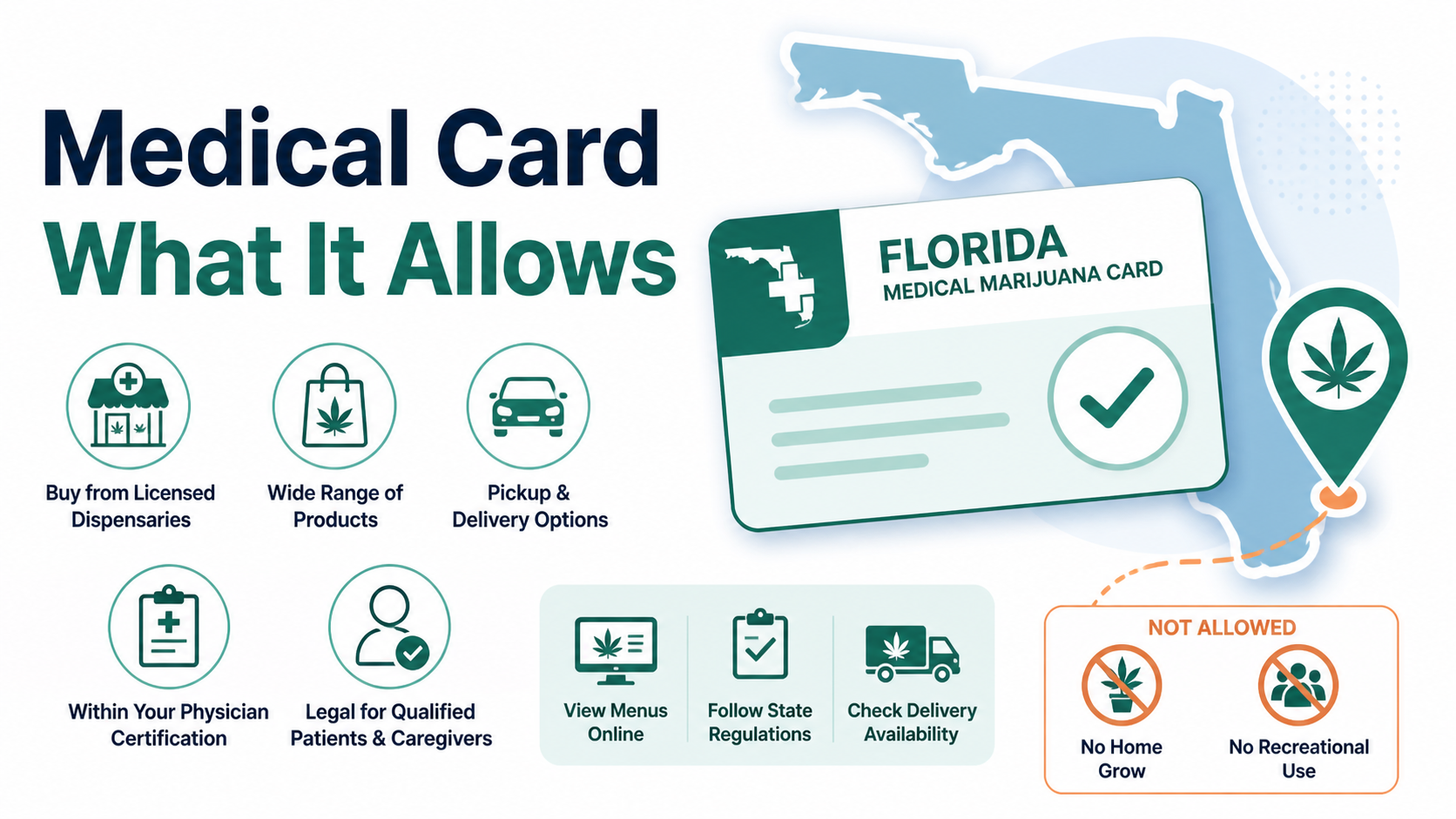
What Does a Florida Medical Marijuana Card Allow?
A Florida medical marijuana card allows qualified MMTC purchases, but it does not guarantee job protection. Check the current Florida limits.
Florida Hemp Laws vs Florida Medical Marijuana Laws
Compare Florida hemp extract rules with Florida medical marijuana rules, including age limits, dispensaries, doctors, COAs, and patient certification.