What Does a Florida Medical Marijuana Card Allow?
A Florida medical marijuana card allows qualified MMTC purchases, but it does not guarantee job protection. Check the current Florida limits.
Quick Answer
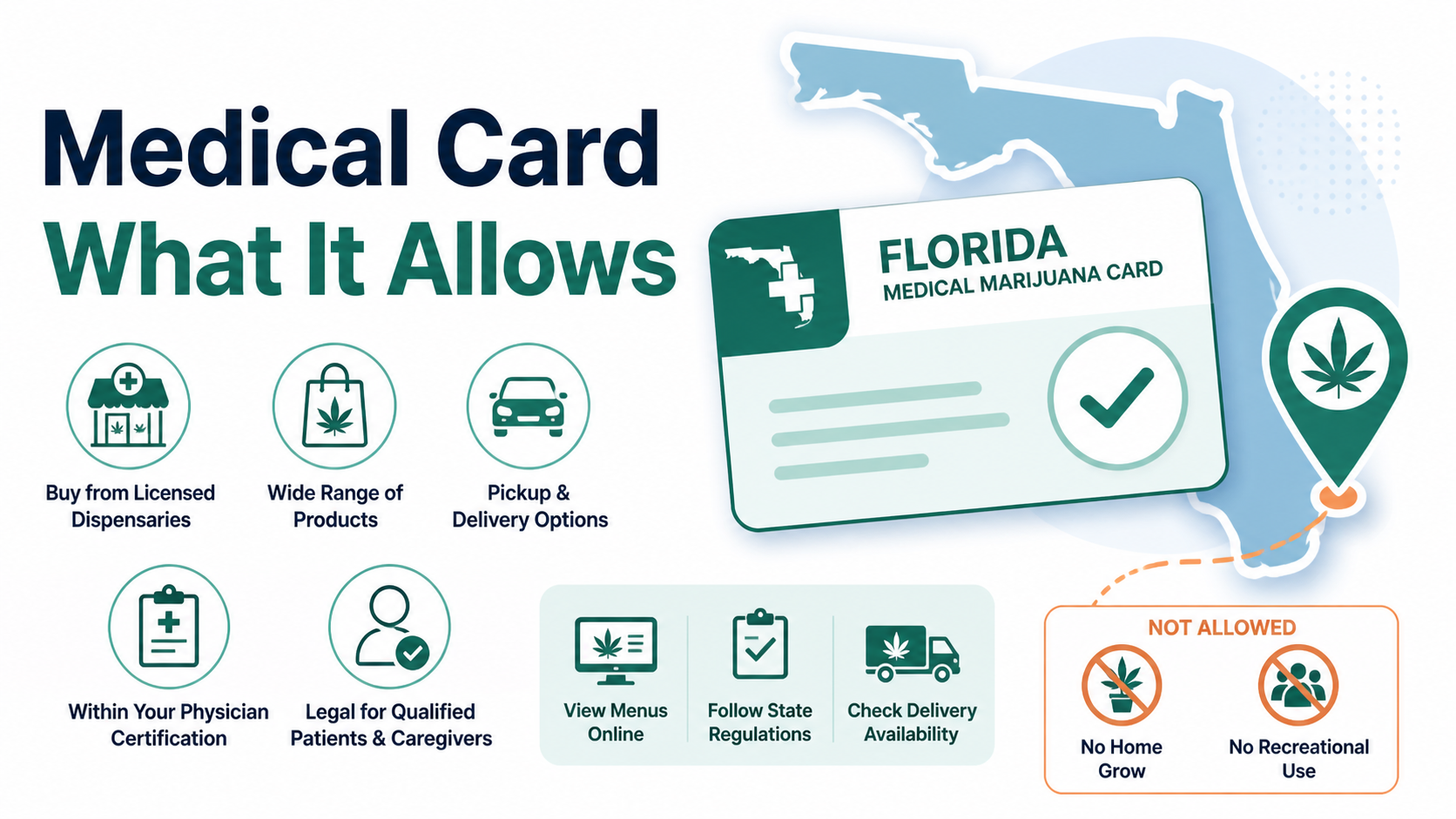
A valid Florida medical marijuana card can allow a qualified patient to buy authorized products from licensed Florida Medical Marijuana Treatment Centers (MMTCs), within the patient's current physician certification, orders, and registry limits.
It is not a general permission slip for cannabis. The card does not authorize recreational purchases, home cultivation, sharing, public use, driving while impaired, or use at work unless the employer permits it. It also does not create automatic protection from workplace drug testing or employment consequences.
That employment limit is especially important after a July 29, 2026 Florida appellate decision involving a firefighter-paramedic. The court reversed a broad trial ruling that had required Hillsborough County to accommodate the employee's off-duty medical-marijuana use. The opinion was expressly narrow: it involved a safety-sensitive job, a collective bargaining agreement, and the County's drug-free workplace policy. It did not decide every possible claim involving every Florida employer.
What a Florida Medical Marijuana Card Can Allow
When the card, physician certification, and applicable orders are current, a qualified patient may be able to:
- Purchase medical marijuana from a licensed Florida MMTC.
- Buy products only within the routes and amounts available in the Medical Marijuana Use Registry.
- Possess and use medical marijuana as authorized by the physician certification and Florida law.
- Use MMTC pickup and, where offered, delivery services.
- Ask a registered caregiver to assist when the caregiver and patient meet the state's requirements.
An active card is only one checkout requirement. The MMTC must also be able to verify the patient or caregiver, the current physician certification, the relevant order, and the available amount in the registry.
What the Card Does Not Allow
A Florida medical marijuana card does not allow a patient to:
- Buy marijuana for recreational use.
- Purchase marijuana from an unlicensed seller.
- Grow marijuana at home.
- Sell, give, or share medical marijuana with another person.
- Ignore physician directions, route limits, or registry amounts.
- Use marijuana in a public place or on public transportation, subject to the limited low-THC exceptions in Florida law.
- Use marijuana at a place of employment unless the employer permits it.
- Drive, operate equipment, or perform safety-sensitive work while impaired.
- Carry marijuana across state lines or assume another state will honor a Florida card.
The card confirms status inside Florida's medical program. It does not replace the separate rules that can apply to work, housing, schools, travel, federal property, firearms, probation, professional licensing, or federal drug-testing programs.
Does a Florida Medical Marijuana Card Protect Your Job?
Not automatically. Section 381.986(15), Florida Statutes, says the medical-marijuana law does not limit an employer's ability to establish, continue, or enforce a drug-free workplace program or policy. It also says the section does not require an employer to accommodate medical-marijuana use in a workplace or an employee working while under the influence, and it does not itself create an employer wrongful-discharge or discrimination claim.
The same statute excludes workplace use from its definition of authorized medical use unless the employer permits it.
Those provisions do not answer every employment question. Another law, a contract, a collective bargaining agreement, a public-employment rule, or a fact-specific disability claim may matter. A cardholder should not rely on the card alone as proof that off-duty use must be accommodated.
What the July 29, 2026 appellate decision changed
In Hillsborough County v. Giambrone, Florida's Second District Court of Appeal reversed summary judgment for a firefighter-paramedic who tested positive for marijuana after random testing. The court directed the trial court to enter final summary judgment for the County.
The majority emphasized several facts:
- The position involved emergency medical care, response vehicles, and other safety-sensitive duties.
- The collective bargaining agreement prohibited cannabinoids and treated a confirmed positive test as impairment for purposes of that agreement.
- The County had a drug-free workplace policy.
- Florida's medical-marijuana statute does not create an affirmative workplace-accommodation requirement.
- The employee's requested accommodation had to be evaluated under the Florida Civil Rights Act and its federal-law framework, not under the medical-marijuana statute alone.
The opinion also limited its reach. It said other employers, different collective bargaining agreements, different policies, and different employment terms were not before the court. The majority did not hold that section 381.986 erases rights or remedies that may exist independently under the Florida Civil Rights Act. A separate concurrence likewise reasoned that the statute does not give employers blanket immunity from every FCRA claim, while concluding that this employee's requested accommodation was unreasonable on these facts.
The case docket was still open when this page was reviewed, and the opinion says it is subject to revision before official publication. A rehearing, mandate, or revised opinion could change the procedural status even though the July 29 opinion currently controls the case's result.
A Positive Test and Current Impairment Are Different Questions
A cannabinoid test can identify a target compound or metabolite under the testing program's rules. A positive urine result does not by itself establish the exact time of use or prove current impairment.
That scientific distinction does not necessarily decide the employment consequence. An employer, collective bargaining agreement, federal program, or licensing rule may define a violation by a confirmed positive result rather than by a separate impairment finding. In the Giambrone case, the collective bargaining agreement itself defined a confirmed positive test as impairment for the agreement.
If testing matters to your job, read the exact policy instead of assuming that medical status, off-duty use, lack of felt intoxication, or a product label will override it. CBD and hemp products can also expose a person to THC, so “non-intoxicating” or “THC-free” marketing does not guarantee a negative test.
What Did the 2026 Florida Employment Bills Do?
They did not become law.
- SB 136 proposed protections for qualified patients employed by public employers, with exceptions and procedures for positive tests. It died in the Senate Health Policy Committee on March 13, 2026.
- SB 1702 and CS/HB 689 proposed forms of employer immunity for certain marijuana-related personnel actions. Both died in committee on March 13, 2026.
A filed bill can describe a policy debate, but it does not change patient rights unless the Legislature passes it and it becomes law. The July appellate opinion and the current enacted statute should not be confused with those failed proposals.
Practical Checklist Before a Workplace Drug Test or HR Conversation
This is general education, not legal advice. Before relying on a Florida card in an employment decision:
1. Get the current written drug, testing, impairment, and accommodation policies.
2. Check whether the position is safety-sensitive, federally regulated, subject to a collective bargaining agreement, or tied to a professional license.
3. Identify the specimen, initial and confirmation process, medical-review procedure, and deadline to respond or contest a result.
4. Keep the card, registry, and physician information private except where disclosure is required or strategically appropriate. A card does not need to be volunteered casually.
5. Ask the employer or union what exact accommodation process applies before assuming off-duty use is protected.
6. Seek a Florida employment attorney promptly if a test, suspension, hiring decision, or termination is at stake. Deadlines can be short.
Do not report to work impaired, drive after use, or use marijuana at work unless the employer and applicable law clearly permit it.
Can Out-of-State Patients Use a Florida Dispensary?
Florida's program is for qualified Florida residents and eligible seasonal residents, plus registered caregivers. Visitors should not assume that an out-of-state card permits purchases at Florida MMTCs.
Seasonal residents may qualify if they meet Florida's documentation and program requirements. Verify current eligibility through the Florida Office of Medical Marijuana Use rather than relying on reciprocity rules from another state.
How to Use Your Card at a Dispensary
Before visiting a dispensary:
- Confirm the operator and address appear on the official OMMU MMTC list.
- Check the operator's official menu, hours, pickup, and delivery information.
- Confirm the state card or approval status is active.
- Verify the physician certification, open order, intended route, and available amount.
- Bring the identification the MMTC requires.
- Ask the MMTC to confirm eligibility before traveling if any registry item is unclear.
Bottom Line
A Florida medical marijuana card provides regulated access to licensed MMTCs when the rest of the registry requirements are ready. It does not make marijuana recreational, permit home grow, authorize use everywhere, prove present impairment or lack of impairment, or guarantee workplace protection.
For employment questions, the current statute, the employer's actual policy, the job's safety and federal requirements, and the facts of any requested accommodation matter more than the card by itself. The July 29, 2026 appellate decision strengthens that warning but should not be stretched into a rule for every worker and every claim.
Sources
- Florida Statutes section 381.986: https://www.leg.state.fl.us/statutes/index.cfm/Sections/index.cfm?App_mode=Display_Statute&URL=0300-0399/0381/Sections/0381.986.html
- Florida Second District Court of Appeal docket, Hillsborough County v. Giambrone, case 2D2025-0115: https://acis.flcourts.gov/portal/court/8f454fb9-4c7f-43df-856b-ab373e71c27f/case/8ff7596e-6b9b-4cae-986d-762357ed7d11
- July 29, 2026 opinion: https://acis-api.flcourts.gov/courts/8f454fb9-4c7f-43df-856b-ab373e71c27f/cms/case/8ff7596e-6b9b-4cae-986d-762357ed7d11/docketentrydocuments/3beb00a5-943b-4e3c-8a60-69008e82b8a9
- Florida Senate SB 136 status: https://www.flsenate.gov/Session/Bill/2026/136/
- Florida House Bill 689 status: https://www.flsenate.gov/Session/Bill/2026/689
- Florida Senate Bill 1702 status: https://www.flsenate.gov/Session/Bill/2026/1702/ByCategory
- Florida OMMU patient information: https://knowthefactsmmj.com/patients/
How this page was reviewed
This guide was checked against the current Florida medical-marijuana statute, the July 29, 2026 Second District Court of Appeal opinion and public docket, the status of three 2026 employment bills, and OMMU patient information. It separates enacted law from failed proposals, a narrow safety-sensitive employment decision from a rule for every worker, and cannabinoid detection from present impairment.
No physician, pharmacist, or attorney review is implied. Personal medical questions belong with a qualified health professional, and current program requirements should be checked with the Florida OMMU.
Sources and verification references
Helpful Next Steps
Move from this guide into practical Florida directory pages, doctor pages, and related patient resources.
Related Guides
Keep comparing Florida medical marijuana, hemp, product safety, and patient access topics.
CBD, CBG, CBN and CBC: Drug Tests, Labels and Safety
Learn what drug tests detect, why CBD or hemp products can still contain THC, and how to read full-spectrum, broad-spectrum, isolate, and COA claims.
What Schedule III Marijuana Means for Florida Patients
A federal rule moved state-licensed medical marijuana into Schedule III. See what changed for Florida patients, what did not, and what the DEA hearing could still change.
Florida Hemp Laws vs Florida Medical Marijuana Laws
Compare Florida hemp extract rules with Florida medical marijuana rules, including age limits, dispensaries, doctors, COAs, and patient certification.