Ways to Use Medical Marijuana in Florida: How the Route Changes the Effects
Learn how inhaled, swallowed, sublingual, topical, and transdermal cannabis differ in absorption, timing, evidence, and Florida route checks.
Route Comparison at a Glance
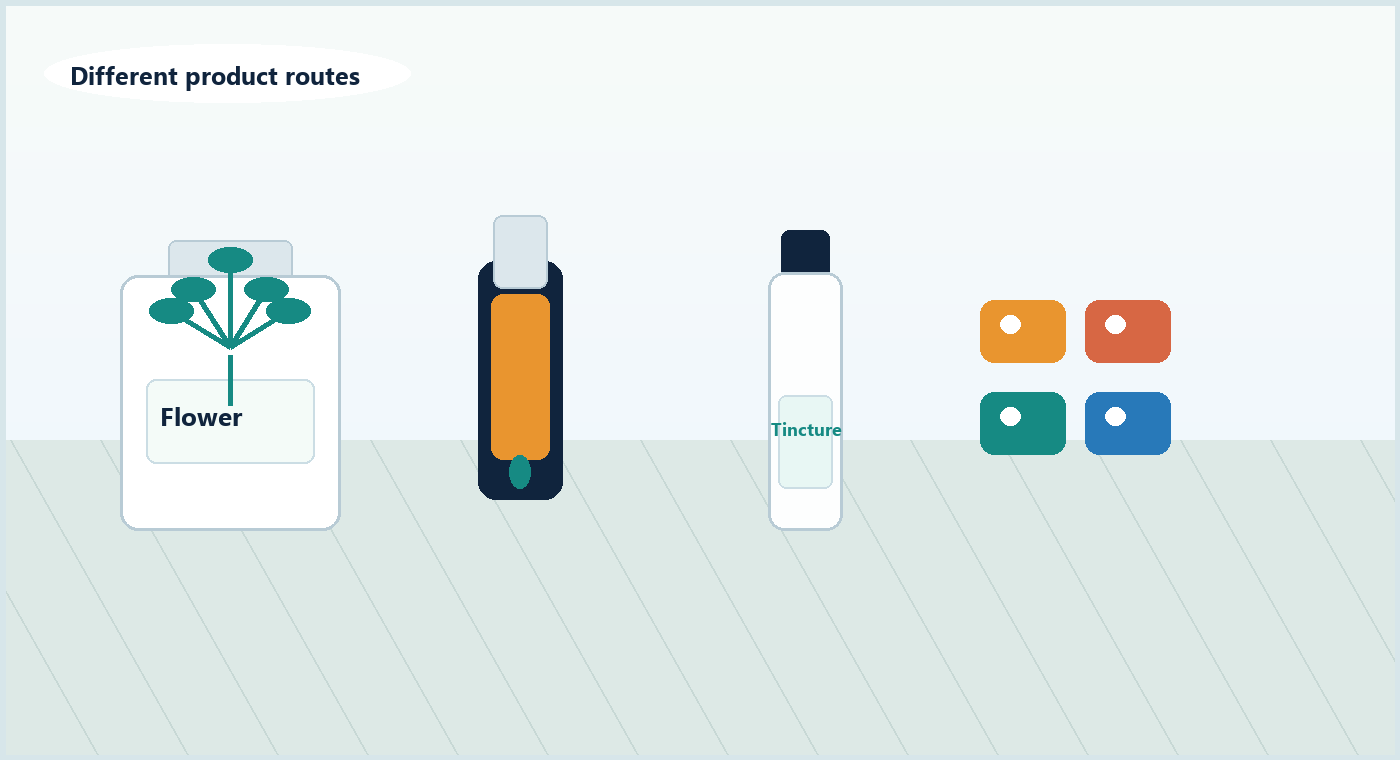
Different routes change how fast a product starts, how long it may last, and how easy it is to adjust.
Usually easier to pause and reassess because effects may begin quickly.
Often slower to start and longer-lasting, so patience matters.
Dropper measurements can help patients compare dose more consistently.
Short Answer
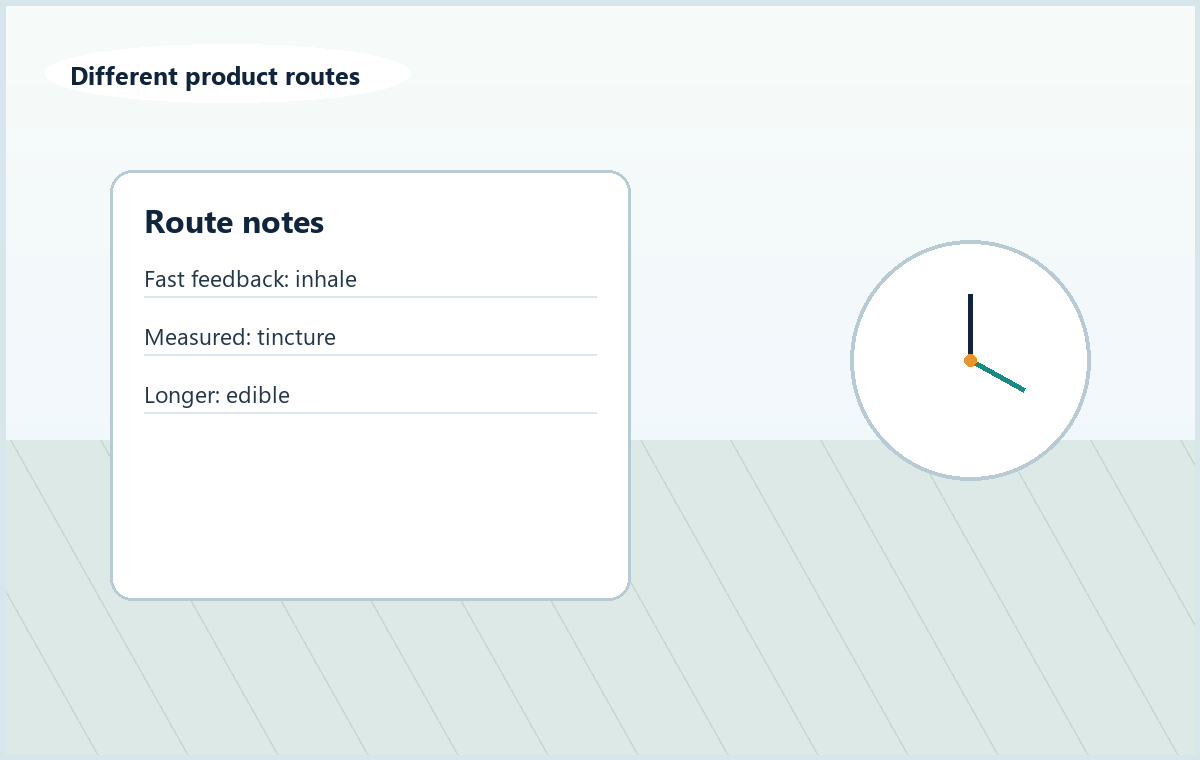
The route is part of the drug exposure. Inhaled THC crosses from the lungs into the bloodstream quickly. Swallowed THC moves through the digestive tract and liver first. Products used in the mouth may be absorbed partly through oral tissues and partly after they are swallowed. Ordinary topicals are intended mainly for the application area, while a true transdermal system is designed to move ingredients through the skin into systemic circulation.
Those paths can change how quickly THC or CBD reaches the blood and how high the early level rises. They can also change what the liver does to THC and how long effects may continue. They do not tell us that one route is medically best for a condition.
This guide explains the science and the Florida shopping checks. It does not recommend a product, dose, or treatment plan.
The Four Questions That Matter
When comparing delivery methods, separate four questions:
- Entry: Where does the product enter the body?
- Liver step: Does it pass through the liver before reaching the rest of the body?
- Timing: How quickly might feedback begin, and how long might it continue?
- Evidence: Was this exact formulation and route studied for the symptom being discussed?
A fifth question matters in Florida: does the route match the patient's physician certification and registry availability? Florida law requires the physician to enter authorized forms and amounts in the registry. Licensed MMTCs check the amount and type when dispensing.
Inhaled Cannabis: Smoking, Dry-Herb Vaporization, Vape Oil, and Inhalers
The lungs have a large surface area and blood supply. After smoke or aerosol reaches the small airways, THC can enter the blood without going through digestion and the liver first. This usually produces faster feedback and an early high point in blood THC. The amount delivered still varies with the product, device, temperature, puffing, breathing, and losses from smoke or equipment.
Smoking and vaporization are not one interchangeable exposure. Smoking burns plant material and creates combustion products. Dry-herb vaporization heats flower without burning it in the same way. Vape cartridges heat formulated cannabis oil. A metered cannabis inhaler may deliver a labeled amount per actuation. Evidence from one format should not automatically be transferred to another.
A controlled crossover study included 17 healthy adults who had not used cannabis in the previous month. Participants inhaled 0, 10, or 25 mg THC as smoked or dry-herb-vaporized cannabis. Equal vaporized doses produced stronger effects and higher blood THC levels than smoked doses in that study. The device changed delivery in this experiment. That does not prove that every vaporizer, cartridge, or patient will behave the same way.
The CDC's cannabis guidance says health and safety risks exist across methods. Smoke can harm the lungs and cardiovascular system, while vaping has been linked to lung injury. Faster feedback should not be confused with lower risk.
Swallowed Cannabis: Edibles, Capsules, Beverages, and Oral Oils
Swallowed cannabis moves through the stomach and intestines. THC that is absorbed then reaches the liver before it reaches the rest of the body. Scientists call this “first-pass metabolism.”
The liver changes some THC into another active chemical called 11-hydroxy-THC. Health Canada's clinical review says more of this chemical is found after swallowing THC than after inhaling it. That helps explain why a swallowed product can feel different, but it does not mean every edible is stronger.
Swallowed cannabis is usually slower and less predictable than inhaled cannabis. Food, the product formula, stomach contents, individual biology, and medicines can change the result. In one Johns Hopkins study, people ate brownies containing 10, 25, or 50 mg THC. THC generally became detectable in blood after about half an hour to two hours. Only six people received each dose, and they were healthy adults who were not current cannabis users. The study measured short-term drug effects, not treatment success.
The CDC warns that edible intoxicating effects may take 30 minutes to two hours to be felt and can last longer than expected. A delayed start creates a practical risk: someone may decide the first serving did not work while absorption is still underway.
Products Used Under the Tongue or in the Mouth
Sublingual means under the tongue. A mouth spray may be aimed at tissue under the tongue or inside the cheek. These routes are designed to let at least some THC or CBD enter through mouth tissue before the product is swallowed.
Real products do not always stay in the mouth long enough for much absorption there. Some liquid or spray is usually swallowed. The body may therefore handle the product partly through the mouth and partly through digestion and the liver. The words tincture, drops, spray, nano, and fast-acting do not predict one standard result.
Controlled studies of standardized mouth sprays cannot be applied automatically to every Florida tincture. Nabiximols, for example, is a standardized THC/CBD mouth spray studied in several countries, but it is not FDA-approved in the United States. A dispensary bottle may have a different formula, concentration, carrier, device, and set of instructions.
The most defensible check is the exact label: intended route, amount per measured unit, total cannabinoids, carrier ingredients, instructions, and warnings.
Skin Application: Topical Is Not the Same as Transdermal
The outer skin is an effective barrier. A conventional cream, balm, or lotion may be intended for local application without reliable systemic delivery. A transdermal patch or gel is specifically formulated to move an ingredient through the skin and toward systemic circulation.
A small 2022 human study found measurable THC and CBD in blood after people used a purpose-built transdermal system. Everyone knew what product was being used, there was no comparison group, and the study measured delivery rather than pain relief. It cannot prove that an ordinary dispensary topical enters the blood or behaves the same way.
Evidence for topical cannabinoids as treatment remains limited. The AHRQ chronic-pain review found too little evidence for firm conclusions about commonly used topical products. It also warned that results from standardized research products may not apply to retail products.
Patients should not infer local relief, non-intoxication, or systemic absorption from the word topical alone. Check whether the label says topical or transdermal, the intended application site, ingredients, warnings, and whether use on damaged skin is prohibited.
Suppositories and Other Less-Studied Routes
Rectal or vaginal products appear in some cannabis markets and research, but there is far less human evidence than for inhaled and swallowed products. The amount absorbed can depend heavily on the formula and placement. A small study showing that a new product entered the blood does not prove that it treats pelvic pain, digestive disease, cancer, or another condition.
These routes raise extra questions about irritation, infection, damaged tissue, pregnancy, and other medicines. The product also needs to be designed and labeled for that use. These questions belong in a clinician conversation, not a do-it-yourself experiment.
More THC in the Blood Does Not Mean More Medical Benefit
Scientists use the word “bioavailability” for how much of a substance reaches the bloodstream. A route that sends more THC into the blood, or sends it there faster, is not automatically more effective, safer, or better for a symptom.
A local product might be designed to limit systemic exposure. A fast inhaled peak may be undesirable for someone sensitive to intoxication or cardiovascular effects. A slower oral product may be impractical when delayed impairment creates a work, driving, fall, or caregiving risk. A studied prescription formulation may not resemble a dispensary product.
Medical evidence must connect the exact cannabinoid preparation, route, dose range, comparison group, patient population, outcome, and study duration. Product marketing usually does not provide that chain of evidence.
What Route Studies Can and Cannot Tell Us About Ailments
Studies do provide useful clues, but they rarely establish a universal route for an ailment:
- Chronic-pain trials have most often studied standardized swallowed products or mouth sprays. Some used purified or laboratory-made cannabinoids. Current AHRQ findings suggest small short-term improvements from some products, with more dizziness, drowsiness, and nausea. Evidence for whole-plant and topical retail products remains too limited for firm conclusions.
- Multiple-sclerosis research includes oral cannabinoids and a standardized THC/CBD mouth spray. That does not prove that a dispensary tincture, edible, vape, or topical has the same effect.
- FDA-approved cannabinoid medicines for certain seizure disorders, chemotherapy nausea, and AIDS-related appetite loss are specific prescription oral products. Their approval is not evidence that a Florida edible or CBD oil treats the same condition.
- Topical and transdermal studies are too limited to select a skin product as a proven treatment route for localized pain.
Read Cannabis Delivery Methods by Condition: What Human Studies Actually Tested for the evidence map behind those distinctions.
A Practical Florida Route Comparison
Before comparing products, write down:
- The route named on the package and in the registry.
- Whether the product is inhaled, swallowed, used in the mouth, topical, or transdermal.
- THC and CBD per measured unit and in the full package.
- Whether the device changes delivery, such as a cartridge battery or metered inhaler.
- Ingredients, carrier oil, allergens, and warnings.
- The physician's instructions and any medicine-interaction questions.
- When driving, work, fall risk, childcare, or caregiving makes delayed impairment especially important.
- What evidence applies to the exact formulation rather than to cannabis in general.
Use the product-label guide, medical-marijuana timing guide, and registry shopping-readiness checklist together.
When to Ask a Physician or Pharmacist
Ask before choosing or changing a route when a medical condition or medicine may change the risk. Important examples include lung, heart, or liver disease; pregnancy; older age; fall risk; and a history of psychosis or substance-use disorder. CBD and THC can affect how the body handles other drugs. FDA guidance warns that CBD can interact with medicines and can sometimes injure the liver.
Route questions are also treatment questions when the goal is symptom control. A dispensary can explain a label and device, but it cannot replace a clinician who knows the diagnosis, medicines, and risks.
Bottom Line
Inhaled, swallowed, mouth-absorbed, topical, and transdermal cannabis products are not interchangeable. The route changes absorption and metabolism; the formulation and device change delivery; and the clinical evidence belongs to the exact product that was studied.
For a Florida patient, the safest comparison is route plus label plus registry status plus professional guidance. Do not let a category name, faster onset claim, or medical-sounding product name stand in for evidence.
Source Note
Primary and official references used for this review include the Spindle smoked-versus-vaporized crossover trial, the Vandrey oral-cannabis pharmacokinetic study, the Huestis human cannabinoid pharmacokinetics review, Health Canada's clinical cannabinoid pharmacokinetics review, the AHRQ living systematic review for chronic pain, CDC cannabis guidance, and Florida Statutes section 381.986.
How this page was reviewed
This guide was checked against controlled human studies of how cannabis products enter and move through the blood, current federal evidence reviews, FDA drug-approval information, official public-health guidance, and Florida law. It separates delivery and timing findings from treatment effectiveness, and it does not transfer results between unlike products.
No physician, pharmacist, or attorney review is implied. Personal medical questions belong with a qualified health professional, and current program requirements should be checked with the Florida OMMU.
Sources and verification references
Helpful Next Steps
Move from this guide into practical Florida directory pages, doctor pages, and related patient resources.
Compare product formats
Use format comparisons before treating two products as the same value.
Review concentrate and vape guides
Check oil type, hardware, storage, COA, and concentrate terms.
Learn deal math
Connect package size, THC mg, units, and final price to value comparisons.
Related Guides
Keep comparing Florida medical marijuana, hemp, product safety, and patient access topics.
Cannabis Delivery Methods by Condition: What Human Studies Actually Tested
See which swallowed, inhaled, mouth-spray, topical, and prescription cannabinoid products researchers studied for pain, spasticity, nausea, seizures, and sleep.
Smoking vs Vaping vs Edibles: What Controlled Studies Found
Compare smoking, dry-herb vaping, vape oil, and edibles using controlled human studies of THC delivery, timing, impairment, and limitations.
How Long Does Medical Marijuana Take to Work?
How fast does medical marijuana work? Compare inhaled, edible, capsule, tincture, concentrate, and topical timing—and what to record before taking more.